Capturing the Veil Nebula Remnant
I captured these two astrophotography images directly from my deck in
Rockingham, North Carolina using the ZWO Seestar S50
smart telescope. Both targets are different sections of the same massive cosmic structure:
the Veil Nebula (Cygnus Loop).
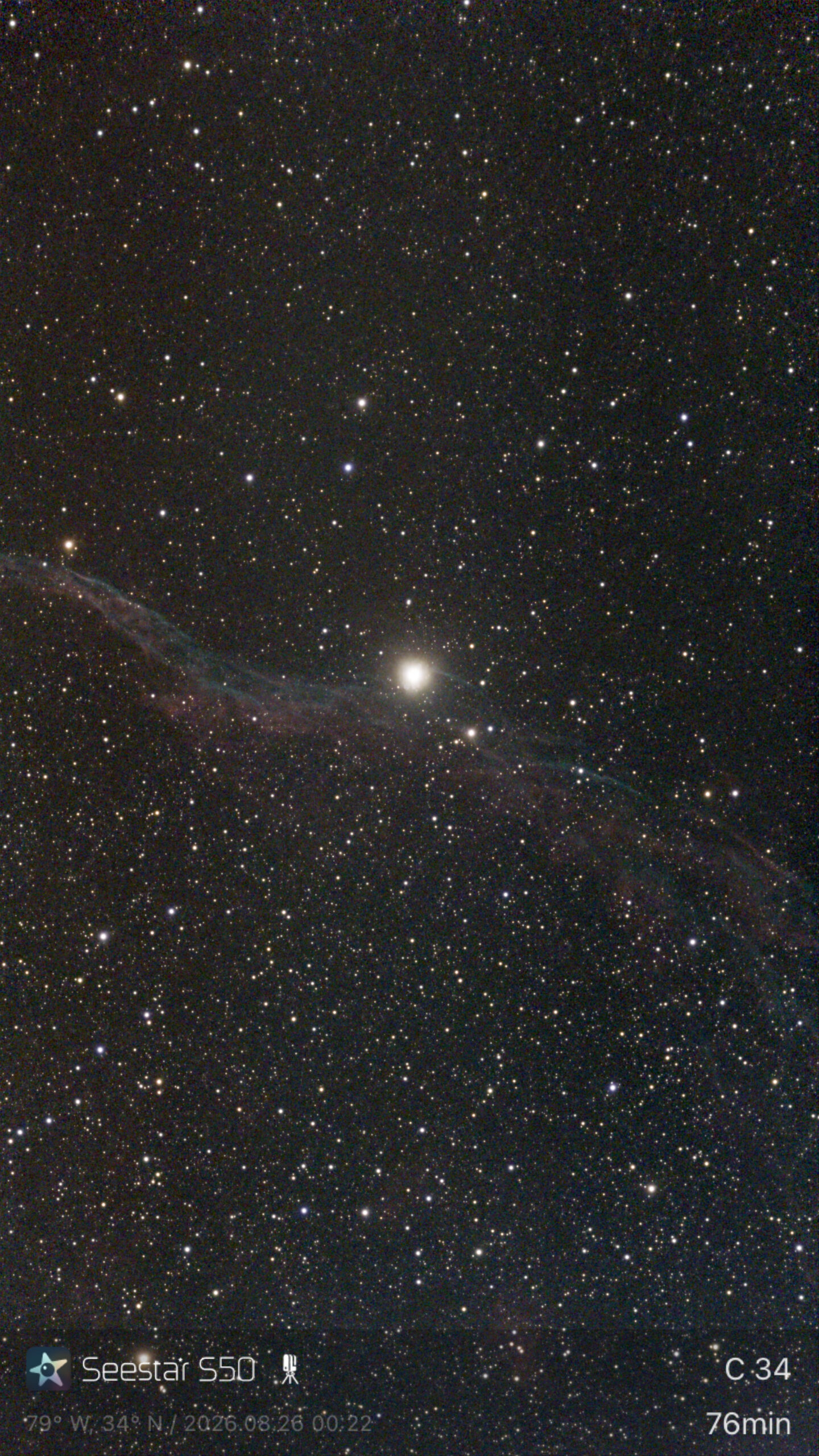
C 34 (NGC 6960) — The Western Veil Nebula
Integration Time: 76 minutes
Commonly called the “Witch’s Broom,” Caldwell 34 features the bright star 52 Cygni near its center. Although 52 Cygni appears in the middle of the nebula, it is actually an unrelated foreground star located closer to Earth.
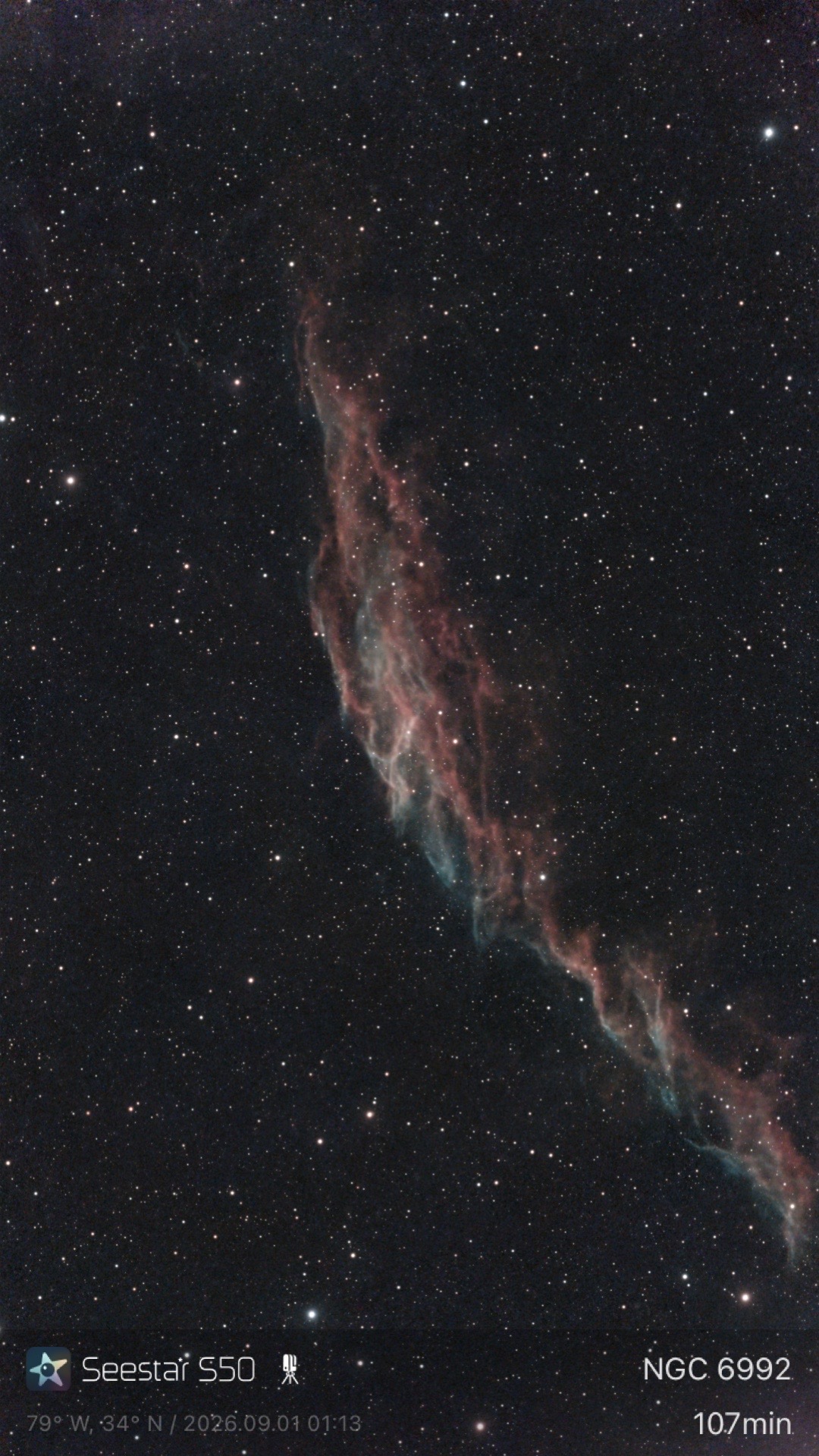
NGC 6992 — The Eastern Veil Nebula
Integration Time: 107 minutes
Also known as the Network Nebula, NGC 6992 forms the eastern outer rim of the expanding supernova shell. The intricate red and blue-green filaments show hydrogen and oxygen gas glowing as the shockwave impacts interstellar dust.
The Cosmic Origin of the Veil Nebula
Between 10,000 and 20,000 years ago, a massive star—roughly 20 times more massive than our Sun—exhausted its nuclear fuel and exploded in a catastrophic supernova approximately 2,400 light-years away in the constellation Cygnus.
The shockwave from that ancient blast continues to expand outward into space at millions of miles per hour. As the shockwave collides with surrounding interstellar gas, it heats the gas to millions of degrees, causing hydrogen (glowing pink/red) and oxygen (glowing blue/green) to emit light.
About the ZWO Seestar S50 Telescope
The ZWO Seestar S50 is an all-in-one smart telescope featuring a 50mm apochromatic triplet lens, an IMX462 sensor, built-in dual-band light-pollution filters, and automated alt-azimuth tracking. It automatically aligns, tracks deep-sky objects, and performs live stacking directly to deliver crisp images even from backyards and decks.