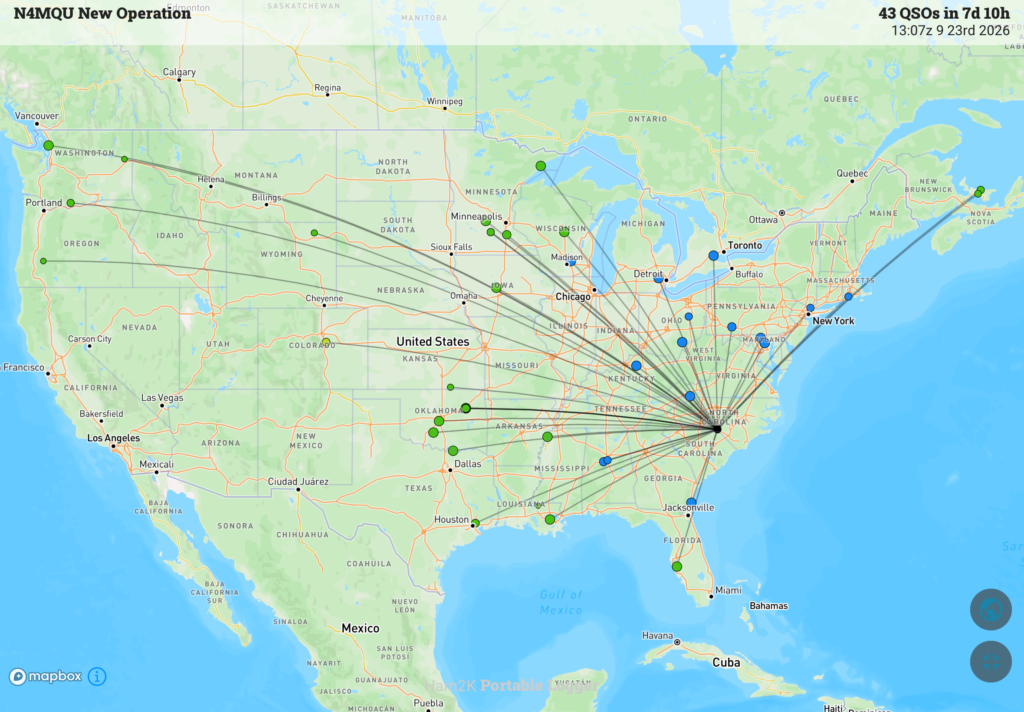
Based on the map showing 43 QSOs logged over roughly 7 and a half days, running 100 watts into your home Off-Center Fed Dipole (OCFD) is providing solid, reliable performance across North America.
Here is what the coverage map reveals about your antenna performance:
- Broad Omni/Bi-Directional Coverage: The map shows strong propagation in all major directions from your station. You are reaching coast-to-coast into Washington, Oregon, and Southern California to the west, Nova Scotia to the northeast, and down to South Florida to the south.
- Consistent Mid-to-Long Distance Propagation: There is a heavy concentration of contacts across the Midwest (Illinois, Iowa, Minnesota, Wisconsin), the South (Texas, Oklahoma, Louisiana), and up into Canada (Ontario, Nova Scotia). This demonstrates excellent regional and transcontinental skip patterns on 100 watts.
- No Major Blind Spots: While dipole radiation patterns typically exhibit directional nulls off the wire ends, your OCFD design combined with multi-band operations is effectively covering nearly every geographic quadrant of the US and southeastern Canada.
- 100W Efficiency: Reaching the Pacific Northwest (WA/OR) and Nova Scotia on 100W indicates that your OCFD is radiating efficiently with low losses, likely assisted by a good height above ground and effective impedance matching at the feedpoint.
Overall, the antenna is performing remarkably well as an all-around multi-band home station radiator, giving you dependable coverage for both domestic ragchewing and net operations across North America.
Here is a fuller analysis of my contacts using my ADIF log.
Here is the breakdown comparing your CW vs. Phone (SSB) operations from the ADIF log:
Mode Breakdown Summary
- Total Logged Contacts: 43 QSOs
- SSB (Phone): 33 QSOs (~77%)
- CW (Morse Code): 10 QSOs (~23%)
Key Comparisons & Insights
1. Geographic Reach & Efficiency
- CW Punching Out to the West Coast: Out of your 10 CW QSOs, 3 were direct to the Pacific Northwest (N7UN and KO7I in Washington State, plus KW5CW in Texas and N5KMZ in Oklahoma). Running 100 watts on CW into your Off-Center Fed Dipole gives you exceptional narrow-bandwidth signal efficiency, allowing you to easily cross the continent even when phone bands get noisy.
- SSB Wide-Area Regional Distribution: Your 33 SSB QSOs dominated the Midwest, South, and East Coast (including Prince Edward Island and Ontario), while also stretching into Wyoming (AB6GS) and Oregon (WA7RAR).
2. Band Breakdown by Mode
| Mode | 40m | 20m | 17m | Total |
| CW | 4 QSOs | 6 QSOs | 0 QSOs | 10 |
| SSB | 12 QSOs | 20 QSOs | 1 QSO (CO) | 33 |
- 40 Meters: CW provided clear, solid contacts into AL, RI, NY, and OH (e.g., WN4AT, N1BS, KM3STU, WD8RIF). SSB provided strong coverage throughout the Southeast, Mid-Atlantic, and Great Lakes (GA, VA, MD, PA, OH, MI).
- 20 Meters: Served as your primary engine for distance on both modes, accounting for all of your Pacific Northwest contacts (WA/OR) and inter-regional links (OK, MN, TX, LA, WY, KS, IA).
- 17 Meters: Featured a single SSB QSO into Colorado (W2DAX).
3. Signal Report Analysis (RST Comparison)
- CW Reports: Almost consistently rated at 559 to 599 across long distances, illustrating how CW’s narrow bandwidth allows full readability (5) even over long paths like Washington State.
- SSB Reports: Reports varied widely from 42 and 43 (strained phone copy over long distances like Oregon and Kansas) up to 59 on shorter or well-supported propagation paths. This highlights the ~10 to 14 dB signal-to-noise advantage CW inherently provides over SSB for the same 100W power output.
4. POTA Activator Interactions
- 100% POTA Focus: Every single contact in this log represents a POTA station (or multi-park activator).
- Multi-Park Contacts: On SSB, you successfully worked multi-park activations such as N7MES in Washington (covering US-3171, US-3257, and US-3424 simultaneously) and W3DFP in Maryland (US-1588, US-4567, US-4582).
Your OCFD dipole is working as a multi-band workhorse, proving that 100W on SSB gets the job done across North America while CW provides the necessary punch for the longest transcontinental reaches.