Navigating the Post-Harvest Moon: Planning Your Dark Sky Windows
For deep-sky astrophotographers and visual observers, tracking lunar cycles is as essential as checking the weather forecast. While a bright full moon provides beautiful nightscape views, it presents a significant obstacle for capturing faint fuzzies like emission nebulae and distant spiral galaxies.
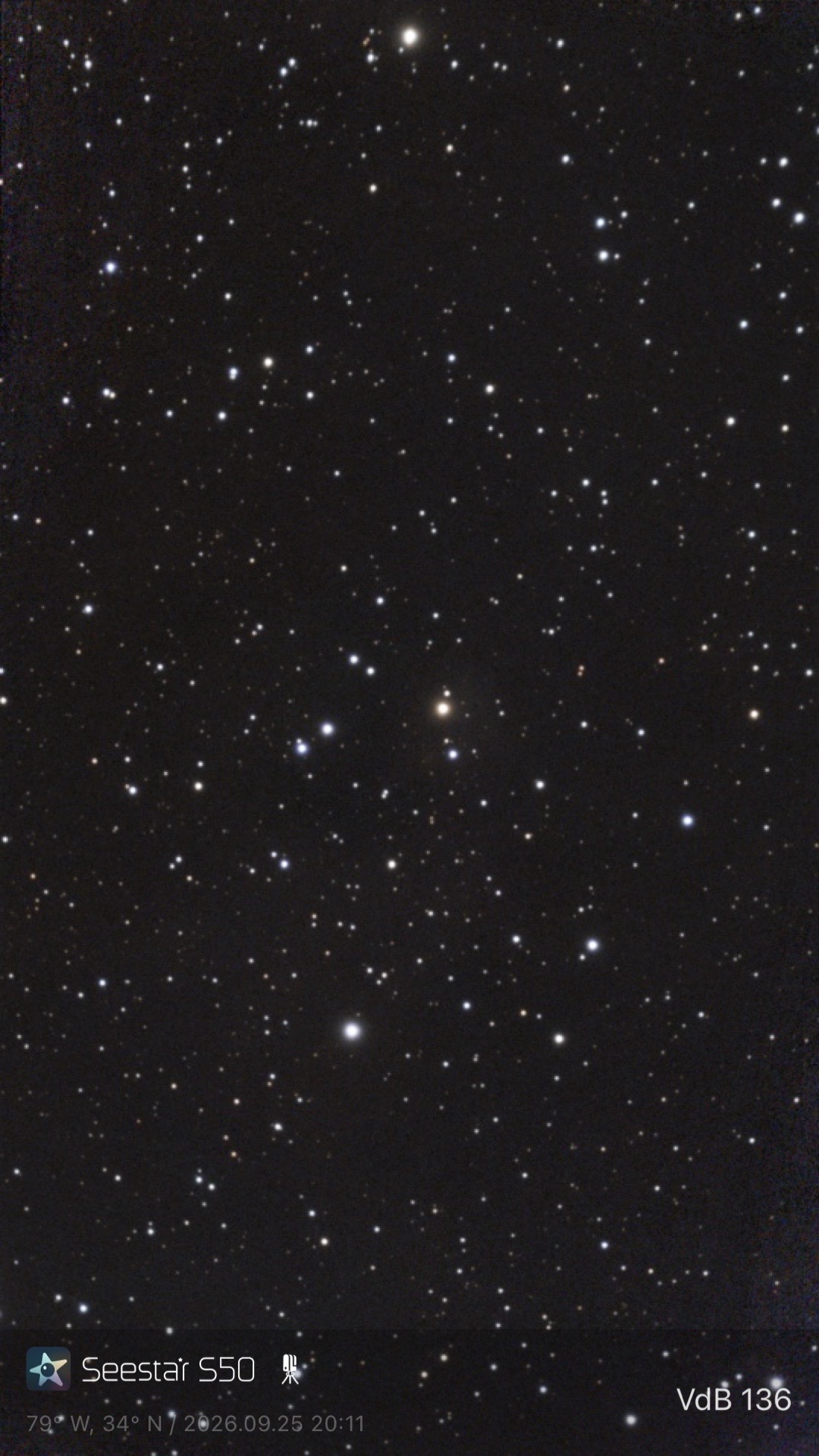
Target Showcase: vdB 136 (van den Bergh Catalog)
vdB 136 stands for entry number 136 in the van den Bergh Catalog of Reflection Nebulae.
- Catalog Name: Named after the Canadian astronomer Sidney van den Bergh, who published the catalog in 1966 listing 158 reflection nebulae visible from the Northern Hemisphere.
- The Object: vdB 136 is a striking reflection nebula located in the constellation Cygnus (the Swan), about 2 degrees south-southwest of the bright star Deneb.
- Key Feature: Unlike typical blue reflection nebulae (which usually reflect light from hot, blue stars), vdB 136 is an unusual yellowish/orange reflection nebula. It shines because dust particles are reflecting light from HD 196819, a 7.5-magnitude red giant star (spectral type K2) embedded within it.
Capturing targets like vdB 136 requires dark skies free of lunar interference to properly extract the subtle yellow/orange dust tones from the rich starry background of Cygnus.
Why Amateur Astronomers Prefer Moonless Skies
- Sky Contrast Loss & High Background Glow: Light reflected by the moon scatters through Earth’s atmosphere (Rayleigh scattering), elevating the overall background sky brightness and drowning out faint visual details.
- Impact on Signal-to-Noise Ratio (SNR): High atmospheric skyglow dramatically reduces your Signal-to-Noise Ratio. Achieving high contrast on fine details like spiral arms or outer faint shells requires significantly longer exposure integration under dark skies.
- Filters Only Do So Much: While dual-band hydrogen-alpha/oxygen-III narrow-band filters mitigate moonlight clutter for emission targets, broadband targets (galaxies, reflection nebulae, and star clusters) suffer heavily under a bright lunar glare.
The Harvest Moon Moonrise Shift
On average, the moon rises about 50 minutes later each night. However, around the Autumnal Equinox (the Harvest Moon period), the shallow angle of the ecliptic relative to the horizon significantly shortens this delay to just 25 to 35 minutes across mid-northern latitudes. As the days progress following the full moon, dark sky windows open up rapidly between dusk and moonrise.
Upcoming Moonrise & Dark Sky Schedule (Rockingham, NC)
Here is the 7-day outlook for twilight and moonrise timings to plan your imaging runs:
| Date | Phase | Sunset | Moonrise | Post-Sunset Dark Window |
|---|---|---|---|---|
| Sat, Sep 26 | Full Moon (100%) | 7:10 PM | 7:01 PM | None (Rises before sunset) |
| Sun, Sep 27 | Waning Gibbous (99.6%) | 7:08 PM | 7:30 PM | ~22 minutes |
| Mon, Sep 28 | Waning Gibbous (96.9%) | 7:07 PM | 8:03 PM | ~56 minutes |
| Tue, Sep 29 | Waning Gibbous (91.6%) | 7:05 PM | 8:41 PM | ~1 hour 36 minutes |
| Wed, Sep 30 | Waning Gibbous (83.9%) | 7:04 PM | 9:27 PM | ~2 hours 23 minutes |
| Thu, Oct 1 | Waning Gibbous (74.2%) | 7:02 PM | 10:23 PM | ~3 hours 21 minutes |
| Fri, Oct 2 | Last Quarter (63.0%) | 7:01 PM | 11:24 PM | ~4 hours 23 minutes |
Tip: Plan your target sessions for Cygnus reflection nebulae like vdB 136 starting Wednesday, September 30th onward to take full advantage of the 2+ hour dark window before the moon rises!